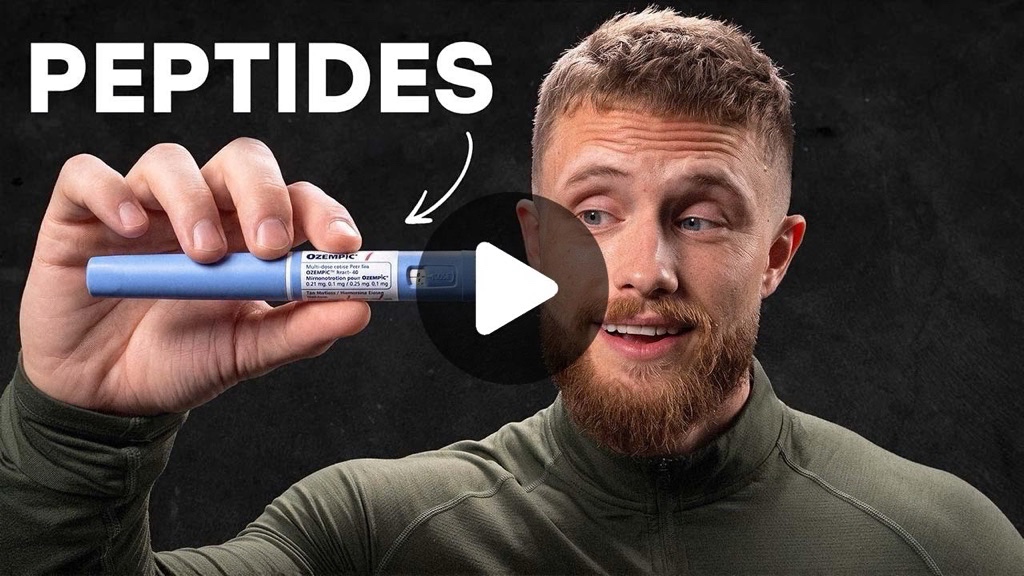
One label. Very different evidence.
Nippard’s central argument: some peptides are effective medicines, but their success does not validate every compound sold under the same label. Evaluate the specific drug, purpose and human evidence.
What a peptide is
Peptides are short chains of amino acids. Nippard uses the relationship to proteins to explain their chemistry, then separates the discussion into weight loss, injury recovery and longevity. Sharing a chemical category does not mean these substances have the same effects or safety profile.
Why the weight-loss drugs work
Semaglutide is his clearest example. It acts on GLP-1 receptors, influencing appetite, stomach emptying and blood-sugar regulation. The practical effect he emphasizes is reduced hunger, making it easier to eat less.
He contrasts this with supplements marketed as metabolism boosters, and points to large, placebo-controlled trials showing substantial weight loss. He also discusses tirzepatide and the investigational drug retatrutide, which act on additional receptors.
The chapter’s takeaway is conditional: effective medicine can be valuable for an appropriate patient, and using it is not a moral failure. It still requires attention to side effects, prescribing criteria and product quality.
- Tolerability matters. The physician interviewed describes nausea, vomiting, constipation and occasional gallbladder problems. “Effective” does not mean risk-free.
- Exercise still matters. Nippard stresses resistance training and adequate protein while losing weight. Appetite control cannot replace exercise’s other benefits.
- The source matters. He criticizes unregulated sourcing and use by already-lean people pursuing further thinness.
Two distinctions behind the headlines
Different trial populations, doses and durations make the video’s weight-loss percentages unsuitable as a direct head-to-head ranking. Its discussion of retatrutide is about research results, not a claim that it is approved.
The video also discusses loss of lean mass. That measurement includes more than skeletal muscle; it should not be read as a fixed percentage of pure muscle loss for every person.
BPC-157: promise is not proof
The injury-recovery chapter contrasts encouraging animal experiments with a much smaller and weaker human evidence base. Nippard describes only a few small pilot studies, without the large controlled trials available for established weight-loss medicines.
He takes recovery anecdotes seriously as reasons to investigate, but explains their central limitation: injuries can improve with time, rehabilitation or changes in training. Improvement after an injection does not establish that the injection caused it.
His conclusion is to avoid recommending BPC-157 on the current evidence he reviews. He favors managing training load, using tolerable exercise variations, rebuilding gradually and getting a qualified physical therapist’s assessment when recovery stalls.
Epitalon and the longevity leap
Nippard introduces telomeres and telomerase to explain why epitalon attracts interest. A plausible cellular mechanism, however, is not evidence that an intervention extends human life.
He describes a narrow, poorly replicated human literature and cautions against translating animal results directly into human longevity promises. His conclusion is that the evidence does not justify recommending anti-aging peptides.
He closes with the habits he considers better supported: exercise, adequate sleep, avoiding smoking, limiting alcohol, maintaining a healthy weight and investing in relationships and community.
What to carry forward
Ask what a particular compound has demonstrated in people, for which outcome, and with what risks. A compelling mechanism, a striking testimonial and a successful trial are different kinds of evidence.
Context beyond the video: FDA identifies limited safety information and potential immune-reaction or impurity concerns for compounded BPC-157 and epitalon. This is an educational summary, not a treatment or dosing plan. Read the FDA’s safety information.
Source & further reading
Summarized from the full audio transcription of Jeff Nippard’s Peptides Are Insane. Chapter times follow the video’s published metadata. Marketing segments are omitted. The explanations above condense the creator’s argument; the expandable clarifications and FDA note supply editorial context.